Thursday, April 24, 2014

Grazia & Graziella

GRAZIA & GRAZIELLA IS A TRIBUTE TO GRANDMA GRAZIA, WHO WITH INFINITE PATIENCE AND LOVE TAUGHT US THE GENUINE FLAVOUR OF WHOLESOME FOOD, AND TO GRAZIELLA, THE FIRST BICYCLE…
THE SCENT OF FREEDOM AND CAREFREENESS OF THE MAGNIFICENT 60’S AND 70’S.
A TRIBUTE TO ITALY THAT RIDES AND SMILES WITH HAIR IN THE WIND.
ITALY AS WE LIKE IT, THE REAL ITALY.
BON APETIT! ENJOY!
ANDREA, ALESSANDRO, SIMONE, RICCARDO, CRISTIAN, EMANUELE

A meal is not only bread and wine. Eating is an emotional experience. We create the atmosphere, with friendly staff who look after you and make you feel right at home. Our chefs and pizza makers pay attention to detail, with proposals and products cooked and designed expressly for you. There are no elements less important than others: a good meal and not just something that fills your stomach, but something enjoyable. Life is too short to refuse pleasures of good food.


  •  Indirizzo:
              Largo M.D. Fumasoni Biondi, 5 (angolo Via della Paglia)           00153 - Roma
  •  Telefono:           06.5880398
  •  info@graziaegraziella.it

Wednesday, April 23, 2014

Peruvian Restaurant "Inka Chicken" in the Centre of Rome

 Local born after 2 years of hard work and effort, to design and build a place that would accommodate each and every guest and offer only the best of Peruvian cuisine. They have created a warm and colorful restaurant, which reflects the spirit of Peru.
INKA CHICKEN  specializes in "Pollo a la Brasa" with an original recipe.Dove are used in place of tastes, aromas and essences taken directly from Peru in addition we are the owner of the machinery necessary for the realization of the "Pollo a la Brasa".The name "INKA CHICKEN" comes from the fact that "Inka" is the Inca Empire and "Chicken" comes from the English (Chicken).
Their food is made of genuine flavors of simple but tasty dishes, but mostly a lot of conviviality . They select the best ingredients for the production of their food and are always ready to welcome you with joy and warmth. The clientele is gradually increasing due to the publicity the world's easiest, word of mouth. Thanks to all our customers "INKA CHICKEN" is growing. We had two meals there trying the chicken and steak and were very impressed with quality , taste, portions and value for money.


Open:
From Tuesday to Sunday
Phone: 064460712
Mobile: 3493231954
Mail:
inkachickenroma@gmail.com
Address: Via Palestro 32/a
Rome-Italy
 

Monday, January 13, 2014

Tavern Allegra


Via Santa Maria della Pieta 30, 80067 Sorrento, Italy
First visit just off the village center and down a side alley in Sorrento. A charming entrance beckons you into this warm and friendly family oriented environment. We located this through trip advisor and it did not disappoint! We were seated in the tavern room warmly lit and filled with wonderful fragrances. This is family owned and run...later lending itself to the great musical event unfolding before our eyes as the meals were being served. A lovely selection of traditional Italian options were served along with Italian wines to compliment the meal. Giuseppe, the Father, shared songs and some very interesting historical information in relationship to the songs. He allowed each table to share where they were from and if any special event was being celebrated. What a wonderful opportunity to meet others traveling from around the world! We had such a wonderful evening that we returned again  2 nights later with our newly engaged daughter and her fiance' who were spoilt with special attention by all the staff who treated the whole restaurant to champagne and special music which we all participated in .It was an unbelievably beautiful evening all the way around with food, wine, music and fellowship. A truly great dining experience!!


You will find Tavern Allegra on 30 of Santa Maria della Pietà street, a typical alley of the city, parallel to Corso Italia avenue, with the start in the  main square, Tasso Square. 
 
 
To have information or reservation
call +39 081/8784221 
info@tavernallegra.com

Friday, December 13, 2013

Casa Sorrentina

Casa Sorrentina (Sorrentinian home) is the name that Sonia, the owner, has chosen to express the atmosphere that lodgers can truly feel during their stay, along with the commodity of lodging just a few steps from the main town square in Sorrento (named after the famous writer Torquato Tasso).
The view from one side of the B&B gives onto the picturesque and stereotypical side streets "vicoletti" of Sorrento, whilst on the other side "il Corso Italia" emerges with its renowned italian fashion shops and boutiques - the perfect place for a mid afternoon stroll.
Sonia's B&B "Casa Sorrentina" is on the first floor of a typical Sorrentino building, located on Corso Italia and only a few steps from Piazza T. Tasso. Characteristics of a classic local building also include only having 2 floors, very sunny rooms and the structure built with a local stone that keeps the heat in winter whilst isolating from the heat in summer.


Corso Italia, 134 - 80067 Sorrento (NA)
Tel. +39 081.878.2738
Fax: +39 081.878.1090
Mobile: +39 334.622.8253 
P.IVA 04284521210


Come Back to Sorrento Lyrics

Luciano Pavarotti & Meat Loaf

Sunday, December 1, 2013

The Villa Borghese Park


The Villa Borghese Park occupies a large area in the heart of the city. The villa contains inside buildings, sculptures, monuments and fountains, works of famous artists from the baroque, neoclassical, eclectic, surrounded by ancient trees, ponds, formal gardens and wide open spaces, made with great care. Provides its visitors with historical and naturalistic itineraries as well as numerous cultural, recreational and sporting activities. Beautiful places are: the Garden of the lake (almost opposite the Casina di Raffaello) where you can rent boats and enjoy, in the middle of the lake, the temple dedicated to Aesculapius, and along the banks of the Sundial and Fountain Family of Satyrs; Secret Gardens (Garden dell'Uccelliera, Old Garden, Sundial Garden and the Garden of Cultivation) reconstructed on the basis of historical documents and iconographic, Piazza di Siena named in honor of the city of origin of the Borghese family, headquarters of the International Horse Show, where you play (even) concerts; Vasanzio of the Casino Borghese, which houses the Galleria Borghese, the Fortezzuola now home to the Parsonage Museum, the Etruscan Museum of Villa Giulia and the Gallery of Modern Art and the Deer Park.
Columbarium via Pinciana: inside Villa Borghese, in the green area of Pineta, at Via Pinciana there are the remains of a columbarium with a square brickwork (m x 5,95 m. 5.40) .
 Of the tomb are well preserved only the eastern and southern walls. . Are still recognizable within four tiers of niches, the lower one with two cinerary urns each. . Orders over instead only a few traces remain. The structure is dated to the second century AD In the first decade of the 1600s the eastern wall of the columbarium was reused as a retaining wall of the loggia of the so-called House of the Janitor, was destroyed during the war of 1849, but well documented in the views made between the seventeenth and the first half of the nineteenth century. I resti sono visitabili dall'esterno. The ruins can be visited from outside.
Historical The construction of the villa was commissioned by Cardinal Scipione Borghese, nephew of Pope Paul V, Flaminio Ponzo and his student John Vasanzio, who was succeeded in 1621 Girolamo Rainaldi. The arrangement of the gardens was architect Domenico Savino Montepulciano. The work ordered by Scipione Borghese lasted from 1608 until 1633, the year of death of the Cardinal. . In this first phase, the villa was divided into three distinct parts separated by masonry fences and gates fences calls. . In the eighteenth century, the restoration and improvement of the Villa Borghese wanted by Marcantonio Borghese and built between 1784 and 1790 by Antonio and his son Mario Asprucci interested in the first place the Casino Nobile and, in later years, the park, where it was made a system of symmetrical and perpendicular streets. Were added to the neoclassical temples of Aesculapius, Diana, and of Antoninus and Faustina. . In the nineteenth century Camillo Borghese and Francis, sons of Marcantonio, enlarged the area of ​​the park and the new landscaping jobs entrusted to Luigi Canina. It was he who planned the Arch of Septimius Severus, the Propylaea Egyptians, Greeks Propylaea.In 1849, during the siege of Rome, the bombing of the French army dealt the British a severe blow to the vegetation and to the furnishings of the villa, the Casina di Raffaello and the Casino of Water Giuochi were practically destroyed, and on the site of the latter a more modest building was built: today's Orangery, so called because there were repaired citrus fruits in winter. I giochi d'acqua non vennero più ricostruiti. The fountains were no longer rebuilt. Villa Borghese fu acquistata dallo stato italiano e destinata a parco pubblico nel 1903. Villa Borghese was bought by the Italian state and a public park in 1903.

Monday, November 25, 2013

Ravello


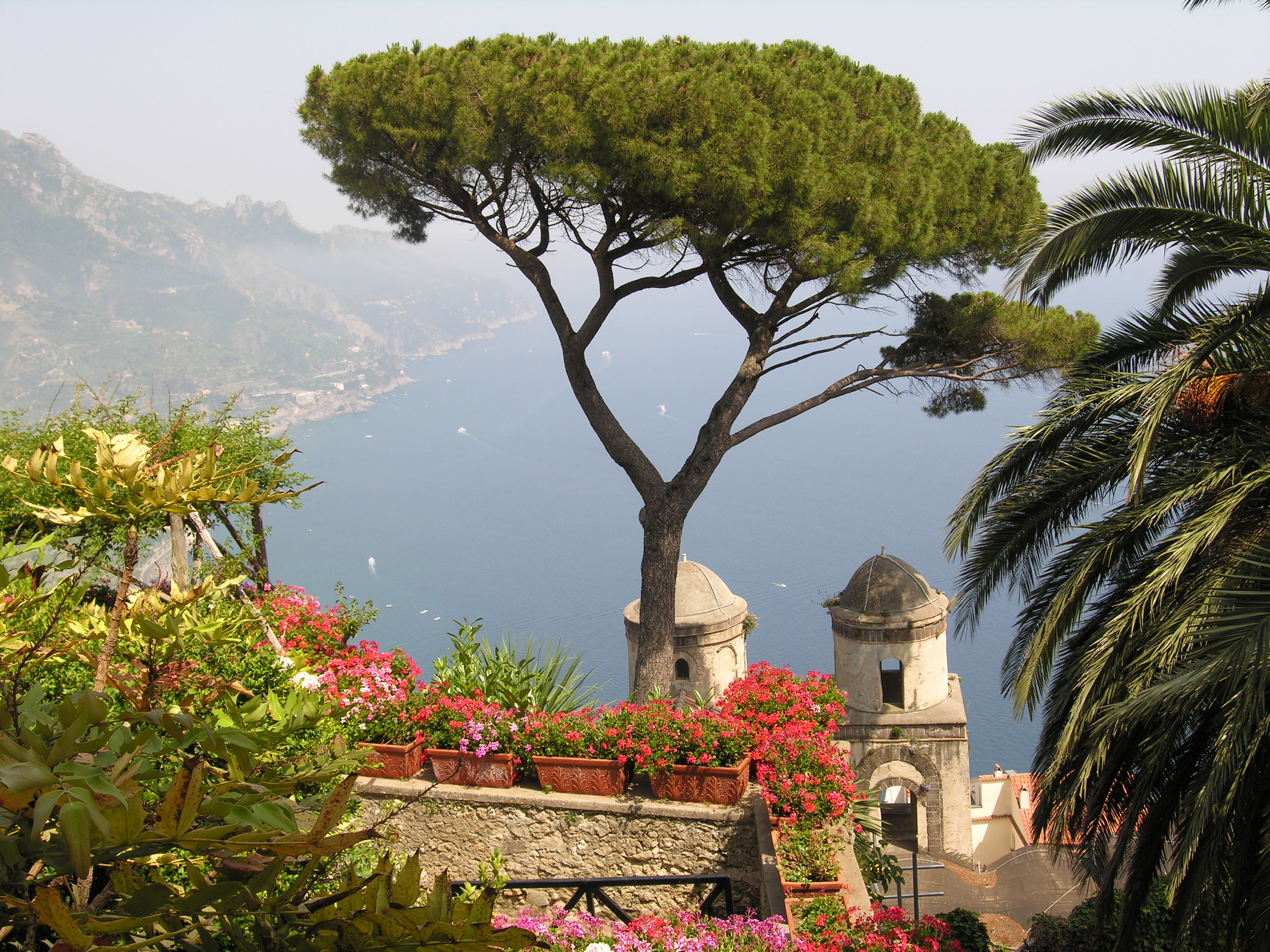
Ravello is a charming and quiet seaside resort, rich of art and history; it is a terrace overlooking the sea (m. 350), from which you enjoys a unequalled scenary of natural beauties. From its viewpoints the Amalfitan coast shows an enchanting vision. The city is known as the Città della Musica because of the classical music concerts held here. It is located on the ridge projecting from the mountain that divides the Valle del Dragone (Dragon's Valley) and del Regina. Based at 350 meters on the sea level, Ravello overhangs the underlying towns of Minori and Maiori. This enchanted place is among the most beautiful in the whole Amalfi Coast, with an intense and unique landscape. It is renowned for its peacefulness and the deep fascination it emanates from each corner and its image is mostly connected with villas with breathtaking views seen all around the world by pictures. Ravello is a village with a very ancient history. It has been built on a rock high 350 meters from the cliffs of the Coast of Amalfi. From Ravello you can see an exalting view, where subsequent terraces declining to the sea have been transformed by the work of generations of men in green terraces cultivated with lemon trees and dotted with white houses. Ravello is like an open terrace facing the sea, a point from which we can appreciate panoramas of unique natural beauty. From its dizzy heights, the view of the Amalfi Coast is simply breathtaking. The places where you can take the most beautiful view are the gardens of the ancient Villas of Ravello: Villa Rufolo and Villa Cimbrone.
Villa Rufolo takes its name from an ancient family of Ravello, rich and powerful in the times of the Maritime Republic of Amalfi. The villa suffered carelessness and degradation until in 1851 the Scottish Francis Neville Reid bought it and brought it again to the ancient splendor. In 1880 Wagner, who stayed in the Villa for some time, remained astonished by the extraordinary glamour of the place and here he found the inspiration to compose the second act of the "Parsifal". From that time, the Villa continued to attract visitors and artists and personages as Jacqueline Kennedy and Illary Clinton. During the summer performances of classic music and ballets of the highest level take place at night in the garden of the villa. The garden becomes a charming scenery, with the orchestra playing on a stage hanging between the sky and the sea.

Villa Cimbrone lies down on seven hectares of rocky terraces peaking on the sea. It had been brought in 1904 by Lord Grimthorpe, who embellished the Villa with antiquities coming from every place of Italy and made in the garden walks of statues and little temples. The most suggestive walk is called "The Walk of the Infinite", because it ends with a belvedere, where the height above the sea and the view can leave you breathless.

Ravello was a bustling centre of commercial activity. Between the XI and XII centuries many trading routes were active among Ravello, the Middle East and Sicily. The Arab-Sicilian architecture of many of the buildings in Ravello still reminds us of those ancient exchanges. Ravello possesses many building of high artistic merit, most of them constructed by wealthy merchants.
The cathedral dates back to the XII century. Its facade has two smaller entrances, which wing either side of the main doors of the marble portal. The doors are in bronze, a fine craft by Barisano of Trani, and date back to the year 1179. The XIII century bell tower is decorated with many ornamental arches.
The dream-like views, the lush vegetation and the charming atmosphere make Ravello a "must see" for those visiting the Amalfi Coast.

What visit in Ravello

* The Cathedral of St. Pantaleone: it was originally built by bishop Papirio in the later 11th century, but has subsequently undergrone considerable alterations, especially in the 18th century, which have alterde its spirit, though leaving its underlying structure substantially intact. The Cathedral is flanked by a handsome campanile dating to the 14th century, and entered through magnificent bronze doors made by Barisanus of Trani in 1179. The interior is notable for its magnificent Pulpit dating to the 13th century. The Pulpit represents a wonderful fusion of the classic, Byzantine and Saracenic style. Opposite it stands a no less magnificent Ambo. The nave and the transepts are decorated with paintings of some value, while the choir is adorned with a handsome episcopale throne and paschal candelabrum. The Chapel of San Pantaleone houses the reliquaries of the blood of the Saint to whom the Cathedral is dedicated.


* Museo del Duomo: it is situated in the crypt and keeps, among other interesting works, the bust of Sighelgaita Rufolo, one of the most beautiful sculptures of the XIII century, the reliquaries of S. Barbara (XII century) and S. Lorenzo (XV century), the altar marble mosaic relics (1272), tomb slabs (XV century) and an outstanding pluteus with relieves and mosaic.

* Villa Rufolo: this made up of a whole series of buildings and gardens set on the wide terraces overlooking the sea, offering a unique panorama of Amalfi's coastline from Capo d'Orso to Conca dei Marini. The wealthy Rufolo family made its fortune trading in the Middle East. They were not only merchants but also skilful bankers, and they built the villa in the 13th century. The villa ws later owned by the Confalone family, the d'Affitto family and, in 1815, it was bought by the Scotsman, Francis Neville Reed, who commissioned Michele Ruggiero to restore it. Over the centuries, the villa has had many illustrious guest, including kings, queens, popes and personalities from the world of art and culture. THe present entrance is in the Torre Minore, with its small arches and Moorish-inspired decorations. The vestibule takes us into a pleasant shady avenue lined with cypress trees, leading to the Cloister or Moorish Courtyard, which is now almost all in ruins. Looking over the balustrade on the right, we can admire what is left of the Cloister or, rather, what has been saved by restoration. The loggia above the ogival arches is composed of small pairs of columns supporting beautiful arabesques, surmounted by more pairs of terracotta columns below the decorated walls. From here we preceed to the upper garden on the right there is a part of the villa which houses animals and fragments from the ancient cathedral. From the top of the 30 metre high Torre Maggiore on the left, we can enjoy a view over the whole of Ravello. This was once the defende tower, with its narrow stairway and simple interior. On the second floor, there are two double mullioned windows on each side, and three round windows, whilst on the third floor there is a series of double terracotta columns like those in the Torre Minore. Beyond the well and the Sala dei Cavalieri, we reach the belvedere, a spacious terrace overlooking the sea, abounding in trees and exotic plants. Two staircases led down from each side of this balcony to the lower terrace with its brightly-coloured perfumed gardens. "This is the magic garden of Klingsor" exclaimed Richard Wagner in 1880, dazzled by the splendour of the colourful flowers and intoxicated by fantastic vegetation. It was in this harmonious setting that the great German musician wrote the 4th scene of Act II of Parfisal. Each year, a series of Wagner concerts are organized in the gardens, in this fairytale, setting against a backcloth of sea and sky.

* Villa Cimbrone: from Villa Rufolo, we take the winding steps up via S. Francesco leading to the church of San Francesco, which is said to have been founded by St. Francis in 1222, and rebuilt in the 18th century. There are two entrances in the atrium the main entrance leads into the church, which has a single nave with two altars on each side. It was originally Gothic, as we ca see from the ogival transept and apse. The church houses the marble tomb of Beato Bonaventura of Potenza, which was transeferred there from San Giovanni del Toro. The smaller door leads to the square Romanesque cloister with its double and single columns. Continuing our journey along past the quiet old buildings to Santa Chiara and its nunery, we finally reach the flight of steps leading to the garden of Villa Cimbrone. The Villa was built by the Acconciagiacomo family, and later taken over by the Fusco family, the Amici di Atrani and finally by William Beckett (later Lord Grimthorpe). To the left the entrance is the Cloister, whit its double mullioned windows, arches and central well, in imitation of the San Francesco clositer. Despie the presence of contrasting elements, the overall effect is very pleasing and orginal in addition to the works in wrought iron, the wooden statues and stuccoes, there are two fine bas-relief sculputures of nine Norman Warriors and the seven Deadly Sins. The crypt is also on the left as we enter, and is an unusual contemporary construction in Gothic style, which offers a fine view over the southern part of the Amalfi coas. The colonnade is composed of twenty-two pillars in grey stone, each with eight horozontal bands both the vault and the arcades are pointed, in mock Gothic style. Our visit continues to the Castle, with its small mullioned and loop-holes in different styles, and its two tower. In addition to housing a fine collection of works of art, many seminars and conferences have been held there, and it has many famous guests. We now begin a tour of the gardens beyond the Ponte del Roseto, along the avenue with its beds of reses, camelias, hydrangeas and geraniums on one side and luxuriant trees and shrubs on the other, we find various construction and ornamental statues Mercury (copy of the Hermes at rest in the Museo Nazionale in Naples), Bacchus' Temple (with a small avenue lined with cypress trees leading up to it), Eve's Grotto with its statue of Venus by the Roman sculptor Tadolini, and a small temple with six columns and wrought-iron dome. We finally reach the Belvedere, a wide balcony decorated wih marble busts, wich offers a marvellous view over the Gulf of Salerno, Punta Licosa, Punta della Campanella and the coast around Amalfi from Capo d'Orso to Conca dei marini. We can also see Maiori, Minori, Catiglioni (Ravello beach), Atrani, and the various district of Amalfi dotted about the promontory abd dominated by the ancient Torre dello Ziro. Our tour of the gardens end at the Roseto, with its staues, amphoras and fountains, and finally the Tea-Room, a rectangular room with columns arrangedin pairs, and walls decorated with arabesques in imitation of the Cloister of Villa Rufolo. Opposite the Tea-Room are four ancient carved columns, two bronze fawns and a stone shell decorated with sea scenes.

Cumpa Cosimo is a one of a kind restaurant with excellent Italian food. You will meet the owner of the restaurant who is a friendly woman, Netta, who makes sure you are satisfied with the quality of your meal. It is a relaxed atmosphere and some dishes are made family style. There is so much to choose from with genuine southern Italian cooking with top quality ingredients. It is a special place that you will not forget. The most authentic restaurant anywhere. Small, very inviting - burning fireplace was very charming. It was as if your long lost Italian grandmother invited you over. She spoiled us with delicious soup, crusty bread and brought my daughter hand-cut "french fries" seasoned to perfection while she waited for her canneloni. The house white wine went perfectly with my linguine with mushrooms. There are not enough good adjectives to describe the personality, quality and value of this restaurant. ---46 Via Roma, Ravello, Italy

 Da Nino Pizzeria Take Away-

Parco Della Rimembranza 35/37, 84010 Ravello, Italy
 
 
What a gem we found in this little take-away restaurant! The pizzas were the best price in town & so delicious. The perfect place to grab delicious, homemade Italian food for a picnic. We also tried all of the grilled verdure--eggplant, zucchini, broccoli, peppers and potatoes--all generously portioned and well priced. Their eggplant parmigiana was one of the best I've tasted. The people that worked there were incredibly friendly.

Saturday, November 23, 2013

Tenuta Vannulo dairy

The best buffalo mozzarella cheese starts with the best care for animals

A queue forms for rub-downs as jazz piano tinkles out of the speakers: some of the best buffalo mozzarella in the world starts with in-stable VIP treatment.
Ducky, Sweety and Lady lumber towards the sound system, attracted to the smooth Keith Jarrett licks at the exclusive Tenuta Vannulo dairy in southern Italy.
 
"The music helps them produce more milk because the animal feels more relaxed," said Valentina Michelucci, astable hand.
The half-tonne black water buffaloes spend their days lounging on rubber mattresses, munching on organic hay or looking forward to vaporised showers that form a fine cooling mist from overhead pipes.
When they feel the urge, they saunter into a special pen for automatic milking by a unique machine that knows the exact shape of each udder thanks to a code emitted by the electronic collars the buffaloes wear.
Or they can head to large round brushes that twist into action when the animals come into contact with them, providing a soothing back and shoulders massage.
"Animals have to be treated well to produce stress-free milk," Antonio Palmieri, owner of the 200-hectare (500-acre) farm said.
"They can't speak for themselves so it's up to us to understand how they want to be cared for," he said, sitting in a manicured garden next to his three stables, which house 500 buffaloes.
The farm sells around 300 kilogrammes (800 pounds) of mozzarella per day for 13 euros a kilo -- nearly $8 a pound.
 
There's just one catch: If you want it, you have to drive to the farm, 50 kilometres (30 miles) south of Salerno, to buy it, as Palmieri does not bother with distribution -- or marketing, for that matter.
Brisk business
Business is brisk anyway, thanks to the dairy's word-of-mouth fame and international reputation among jet-setting buffalo milk aficionados.
Around 45,000 customers visited the on-site farm shop in August alone.
 
The staple remains mozzarella but Vannulo also make a range of buffalo milk-based products including yoghurt, ice cream and, starting next year, chocolate.
Vannulo's "is widely regarded as the best mozzarella," said Piero Sardo, president of the Foundation for Biodiversity at Slow Food, an Italy-based international gourmet and eco-friendly farming group.
"The well-being of animals is an important issue," said Sardo, a cheese expert, although he admitted that the link between better treatment and tastier milk was scientifically "difficult to prove".
The history of buffalo dairying in Italy has been traced to the 12th century, but it remained a mainly local affair until relatively recently because of the difficulties in refrigerating the milk.
Before the 1980s, most dairies in the region were small producers like Vannulo.
But in recent years, buffalo mozzarella has gone international and is now prized in the best restaurants from Dubai to Moscow to Sydney. The coveted cheese sells for 30 euros a kilo in Russia.

Wednesday, November 6, 2013

Best Food to Eat in Campania

Best Food to Eat in Campania
By Lisa Fantino
Italians love to eat but the cuisine of the northern region of Tuscany is quite different from that of the southern region of Campania. Northern dishes are traditionally more meaty and hearty, like a ribollita; while those in the south highlight fish because of their proximity to the sea. Yet, that’s not to say that any less attention is given to incredible pasta dishes and desserts. So here are the Top 5 dishes to try while touring Campania

Sfogliatella – No trip to Naples or Amalfi would be complete without trying one of these delicious pastries for breakfast. The multi layers of light dough are formed into the shape of a seashell and offer the perfect crunch to compliment your morning latte or cappuccino.
AUTHOR’s PREFERENCE – while I have eaten fantastic sfogliatelle in Campania, some of the best I have ever tasted can be found at the coffee stands inside Rome Fiumicino airport.

Farfalle alla Caprese – These little bowtie or butterfly shaped pasta are cooked al dente and tossed with select virgin olive oil, fresh mozzarella, basil, garlic and sun-ripened tomatoes which have the unique flavor of the lava-rich hills of the region. This is served at room temperature but can be served hot so that the cheese just melts over the pasta.


Fried Zucchini Blossoms – This is a seasonal delicacy that always seems to magically appear on the Amalfi Coast no matter the time of year. In Campania, they stuff these tender orange flowers with ricotta and batter and fry them. You will not find these on the so-called “tourist menu” which offer things like


Chicken Parmigiana, Mamma mia!


Stuffed Calamari or Cuttle Fish – stuffings are as varied for this little squiggly fish as the day is long. However, the stuffing is what makes this dish. Breadcrumbs are the base to which various ingredients such as pignoli, raisin, gorgonzola, onions, garlic and seasoning are added. They are then baked and served as an entrée. They are cooked to perfection when the fish just melts in your mouth.


Dolce – The Napoletani enjoy their desserts. One of the most enjoyable pastimes is to grab a café in a piazza, along with a babbá (rum-soaked cake).

Thursday, October 31, 2013

Tomb of Saint Peter and the Necropolis

Visits to the Tomb of Saint Peter and the Necropolis
under the Vatican Basilica

Special visits to the necropolis underneath the Basilica, where the tomb of St. Peter is located, are only possible following special permission granted from time to time by the “Fabbrica di San Pietro”. Visits are organized according to the schedule set by the Excavations Office.


- In order to preserve this exceptional historical, archaeological site and due to the limited premises around the venerated tomb of the Apostle Peter, only around 250 visitors per day are permitted to enter.
- Groups are composed of approximately 12 people and according to language.
- Only those who are 15 years or older will be admitted – no exceptions will be made.
- Each group is accompanied by a guide especially trained by our office.
The guided visit lasts about an hour and a half. 
We kindly inform all visitors to the necropolis that environmental conditions will be different underground, with possible increase of temperature and humidity. Those who suffer specific and serious physical problems that could be effected by these conditions, including claustrophobia, should not visit.

Virtual Visit:
Explore the Vatican Necropolis online by clicking the following link:
http://www.vatican.va/various/basiliche/necropoli/scavi_english.html

RESERVATIONS:
Requests, if possible, should be sent directly by the interested visitor/s.  If the person submitting the request is not the actual visitor, he or she should send the visitor(s) name(s) and e-mail address(es).  This will allow the Excavations Office to replay back to the person requesting the visit and to the visitor with specific information about the visit granted. 
Those leading groups (universities, parishes, cultural associations, agencies, and other groups) should send a complete list of names of the  participants and the name of their organization.
There are no set deadlines for submitting requests.  All requests, even urgent ones, will be fulfilled depending on the places left available at the closest date to the one requested.
Requests may be submitted in written form by sending a message to scavi@fsp.va, by fax +39 06 69873017, or by visiting the Excavations Office in person (using the south [left] entrance, just outside of the Colonnade).
It is absolutely necessary to provide the following information:
1.  Exact number of participants;
2.  Names of participants;
3.  Language requested;
4.  Possible dates *when the Excavations Office can assign your visit (the time will be determined by the Office). *please always write in full the name of the month (e.g.:  from 01 January 2013 to 08 January 2013)
5.  E-mail address, or fax number, or a complete postal address.


ENTRANCE FEE:
The cost of the individual ticket, including the contribution for the Guide, is 12,00 Euros(approximately $ 15.50 USD)
[From January 1, 2013: The cost of the individual ticket is 13,00 Euros(approximately $ 16.50 USD)]. 
No reductions in price will be given for any reason.

REGULATIONS DURING VISITS:
Arrive at the Excavations Office at least 10 minutes before the scheduled time of the visit.
Clothing should be appropriate for a sacred place:  long trousers/slacks/jeans for men; dresses that reach below the knees or long trousers/slacks/jeans for women; shoulders must be covered for all.
Entrance to the Excavations Office is only through the gates located on the Via Paolo VI (outside of the Colonnade, just to the south [left], near the entrance to the General Audience Hall.)  Upon arrival, present the Swiss Guards with your letter of confirmation received from the Office which indicates the scheduled time of your visit.

Depositing prohibited items:
The following objects are absolutely prohibited during the visit:
luggage / large bags
backpacks /cameras
These [and similar] objects must be deposited before reaching the Office.
A DEPOSIT area free of charge for these objects is available to the right of the façade of the Basilica at ground floor level of the Basilica's premises passed the security check areas.  We are glad to provide this service and the objects deposited are supervised by our staff.
Anyone who does not observe these regulations will not be allowed to participate in the visit.

OFFICE HOURS:
Monday – Friday: 9:00 a.m. – 6:00 p.m.
Saturday:9:00 a.m. – 5:00 p.m.
The last visit always begins at 3:30 p.m. (4:15p.m. from April through September).
ClosedSundays and Vatican Holydays

Ostia Antica

 
General information regarding Ostia Antica's excavations
 For additional information regarding the archeological site, you are pleased to contact directly the 'Soprintendenza' and the ticket office, you'll find their contacts at the bottom of this page. But please, make sure to read this page before doing that, you'll probably find the answers to most of your questions.
The best period to visit the excavations is surely the spring, from half March till the end of May. Another good period would be from the end of September to the beggining of November (weather allowing).
Ostia Antica's excavations timetable
Closed every Monday and in the 1st of January, 1st of May and on the 25th of December.
 January and February, November and December:
08.30 - 16.00 (public exit within 17.00)
March:
08.30 - 17.00 (public exit within 18.00)
From the Daylight saving time beginning (last Sunday of March) till October:
08.30 - 18.00 (public exit within 19.00)
From the last Sunday of October (end of Daylight saving time) till the 1st of November:
08.30 - 17.00 (public exit within 18.00)
    Tickets information--Ticket € 8,00--Reduced ticket € 4,00
 How to reach the archaeological site
The address of the excavations is:
Scavi di Ostia - Via dei Romagnoli, 717 - 00119 Ostia Antica - Roma
By car you need to follow the signs to Ostia Antica, the excavations are along the main street (Via dei Romagnoli). You won't have problems finding them.
By metro if you are in the middle of Rome, for example at Termini, you need to take the line B direction Laurentina till Magliana (will take around 7 minutes) and from Magliana take the metro to Lido di Ostia till at Ostia Antica (will take around 20 minutes). As soon you are out of the station you'll see a blue foot bridge in front of you, cross it and keep going straight till you'll reach a fountain, cross the road in front of it and again keep going straight till the gate of the excavations (less then 2 minutes).
 Other useful information-- It's possible to reserve a guided tour from Tuesday to Sunday contacting the ticket office.  It's possible to have an audio guide in Italian, English and French, ask at the ticket office.  It's not allowed the access to the excavations with transportation which can stop at the checked parking (paying) close to the ticket office.
  Within the excavations, right beside the Ostiense Museum and the offices, there's a cafe, restaurant and a bookshop.

Getting to Ostia

Getting to Ostia Antica from downtown Rome is a snap — it's a 45-minute combination Metro/train ride to Ostia Antica. It'll cost you just one Metro ticket each way. From Rome, take Metro line B to the Piramide stop (which really is next to a pyramid, and several other interesting sights — it's worth a quick stop). The Piramide Metro stop is also the Roma Porta San Paolo train station, so the train tracks are just a few steps from the Metro tracks — follow signs to Lido. All trains depart in the direction of Lido, leave every 15 minutes, and stop at Ostia Antica along the way. The lighted schedule at each track will read something like, "Treno in partenza alle ore 13.25," meaning, "Train departing at 13:25." Look for the train departing next, hop on, ride for about 30 minutes (keep your Metro ticket handy), and get off at the Ostia Antica stop. (If you don't have a ticket to get back, purchase one at the ticket window at the station, or from the nearby snack bar.)
Leaving the train station in Ostia Antica, cross the road via the blue sky-bridge and walk straight down Via della Stazione di Ostia Antica, continuing straight until you reach the parking lot. The entrance is to your left.
History

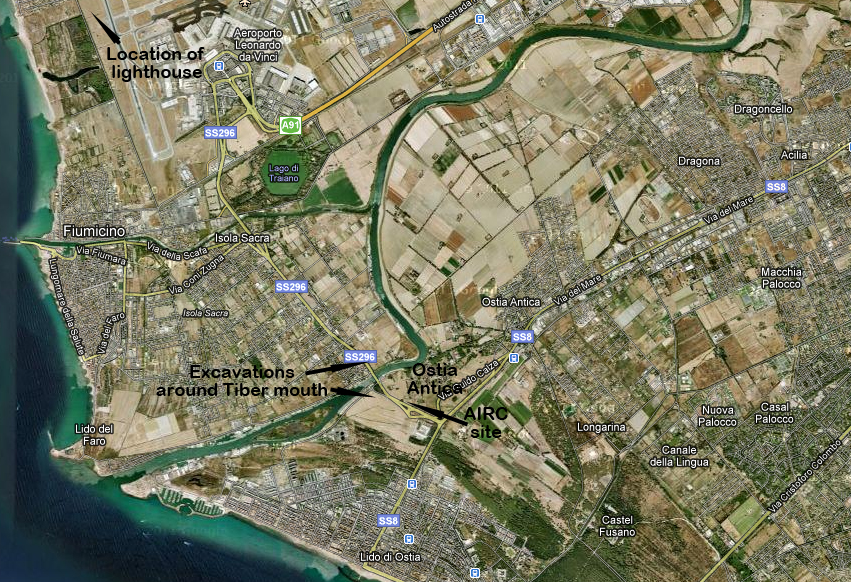
Located at (and named for) the mouth (ostium) of the Tiber, Ostia was founded about 620 B.C. Its main attraction was the salt gleaned from nearby salt flats, which was a precious preserver of meat in ancient times. Later, as Rome began expanding (around 400 B.C.), Ostia was conquered, and a fort, or castrum, was built here. Ostia — often called Rome's first colony — served as a naval base, protecting Rome from any invasion by river. By A.D. 150, when Rome controlled the Mediterranean, Ostia's importance became commercial rather than military. Rome eventually outgrew the port of Ostia, and a vast new port was dug nearby (where Rome's airport now stands). But Ostia remained a key administrative and warehousing center, busy with the big business of keeping more than a million Romans fed and in sandals. With the fall of Rome, the port was abandoned. Over time, the harbor silted up, and the Tiber retreated to about one mile away. The mud that eventually buried Ostia actually protected it from the ravages of time — and stone-scavenging medieval peasants.

Ostia Antica Tour

    
Consider your visit a three-part affair:
1. Follow this tour, which leads you straight down Decumanus Maximus (the town's main drag), with a couple of slight detours, finishing at the forum (the main square).
2. Pop into the museum and consider getting a bite to eat at the cafeteria.
3. Explore the back lanes — going on a visual scavenger hunt — as you wander your way back to the entry point.
1. Cemetery (Necropolis): Find the map (30 yards inside the gate) for an orientation. Notice how the core of Ostia is a rectangular Roman military camp with two major roads crossing at the forum. One of four city gates lies ahead, and on your left is the necropolis (cemetery). Ancient Romans buried their dead outside the city walls. Detour to find family sepulchres — private open-air rooms lined with niches for ash-filled urns. Until the first century A.D., cremation was common. In the second and third centuries A.D., the Romans here buried their dead in marble and terra-cotta sarcophagi in tombs.
2. Porta Romana: Ahead (where the road gets narrow) you enter the ancient city of Ostia through the scant remains of the gate Porta Romana. Just as Rome's Porta Ostiense faced Ostia, Ostia's Porta Romana faced Rome. Just inside to the left (under the big tree), you can see on the gate the bits of the Latin inscription that greeted all who entered. It reads: "The Senate and the people of the colony of Ostia constructed the walls." The "colony" reference is a reminder that Ostia was the first bit of the Roman Empire.
From the gate, Ostia's main street (named Decumanus Maximus) leads straight to the Forum, where this walk ends. Note that this road was elevated above some buildings' foundations. Over the centuries, Ostia's ground-level rose. You can actually identify buildings from the Republic (centuries before Christ) and the empire (centuries after Christ) by their level. Anything you walk down into is from the earlier period.
3. Republican Warehouses (Magazzini Repubblicani): The first century B.C. was busy with activities relating to the river port. Walking along the main street you pass vast warehouses on the right. The goods of the port, such as grain from Sicily, Egypt, and all of North Africa, were processed and stored in warehouses here before being consumed by Rome.
4. Baths of Neptune (Terme di Nettuno): At the little well in the road, you'll see a viewpoint (with railings, above on right). Climb up for a view of the Baths of Neptune, including a fine mosaic with Neptune riding four horses through the sea. Apart from the cupid riding the dolphin, the sea looks pretty frightening — which it was. The large square to the left of the mosaic would have been busy with people wrestling, stretching, doing jumping jacks, and getting rubdowns. The niches that ring the square housed small businesses.
Climb back down, turn right, and immediately take another right. About seven yards in, on your right as you enter a grassy square, you'll see mosaics of ancient Roman boxers (mosaico degli atleti). Continue around the square until you reach an exit directly opposite the entrance. Follow the path to your left (paralleling the main street) as it crosses a typical street lined with apartments (insulae), to get to the Square of the Guilds.
5. Square of the Guilds (Piazzale delle Corporazioni): This grand square evolved from a simple place — where businessmen would stroll and powwow together — to become a monumental square lined with more than 60 offices of ship-owners and traders. This was the bustling center of Rome's import / export industry. Along the sidewalk, second-century A.D. mosaics advertise the services offered by the various shops. Walking counterclockwise, circle the square to "read" the mosaics that advertised in Latin and in a sign language for illiterate or non-Latin-reading sailors. The most common symbol — the lighthouse — was the sign of the port of Ostia. Grain containers are reminders that grain was the major import of Ostia. The elephant marking the office of the Sabratans (a place in present-day Libya) symbolized the sale of ivory or perhaps of exotic animals (great for parties and private spectacles). One shipper advertised that he dealt with Narbon (Narbonne in present-day France).
In the far corner you'll see a mosaic showing porters loading containers from a sea-going ship to a river-going ship and the three-mouthed delta of a river (probably the Nile). Statues of notable local guild-members and business leaders decorated the courtyard. The temple in the center was likely related to Ceres, the goddess of harvest and abundance (prosperity from good business). As you leave, notice the small white altar on the right. This would have been used to sacrifice animals — such as the rams carved into the corners — to ask for favor from the gods. The entrails would be read to divine the future, and to determine whether the gods were for or against a particular business venture. Ahead of you, in the direction of the Decumanus Maximus, is the theater.
6. Theater (Teatro): Up to 4,000 residents could gather here for entertainment. The three rows of marble steps near the orchestra were for big shots. While this theater seems big, it was twice as high in ancient times. (The upper two-thirds of what you see today is reconstructed.) In its day, a wall rose behind the stage, enclosing the theater. Even today, this place — one of the oldest brick theaters anywhere — is used for concerts. Climb to the top of the theater for a fine view.
7. Mill (Molino): The next intersection is Via dei Molini, which marks the wall of the original military castrum (rectangular camp). Before continuing into that oldest part of Ostia, turn right down Via dei Molini and (after nearly 2 blocks), turn left into the mill building (panificio), which dates from A.D. 120. Before you are several lava millstones that were used to grind grain. Study the workings: A bowl-like lower structure carefully cupped a moving upper section. Grain would be sprinkled in from a sack hanging from the ceiling. Mules or workers would power the grinding by walking in circles, pushing inserted wood poles. Powdery flour (with not much grit) would eventually tumble out of the bottom of the mill, ready to made into bread. A nearby room contains two ovens. Now, backtrack down Via dei Molini and take the first right onto Via Casa di Diana.
8. Via Casa di Diana: There are three places of interest along this street: the House of Diana, a tavern, and stairs leading to the second floor of an apartment flat for a commanding view.
The House of Diana is a great example of an insula (a multistoried tenement complex where the lower middle-class lived). The House of Diana originally had three or four floors (reaching the 66-foot maximum height allowed by Ostia's building codes).
Across the street, and down another 30 yards, is an inn called the Insula of the Thermopolium. Belly up to this tavern's bar. You'll see display shelves for food and drinks for sale, a small sink, and scant remains of wall paintings.
Across the street, stairs lead to the top floor of the Insula of the Paintings. Climb these for a good view and a chance to imagine life as an apartment dweller in ancient Rome. Now, walk on toward the high red brick temple that marks Ostia's Forum.
9. Forum: Whenever possible, Rome imposed a grid road plan on its conquered cities. After Rome conquered Ostia in about 400 B.C., it built a military camp, or castrum — a rectangular fort with east, west, north, and south gates and two main roads converging on the forum. Throughout the empire, Romans found comfort in this familiar city plan.
Ostia's main square became a monumental Forum in Imperial period. And dominating this square, like most Roman towns, was the grand temple (from A.D. 120). The marble veneer was scavenged in the Middle Ages, leaving only the core brickwork. Note the reinforcement arches in the brick. The temple, called the Capitolium (after the original atop Capitol Hill in Rome), was dedicated to the pagan trinity of Jupiter, Juno, and Minerva. A forum dominated by a Capitolium temple was a standard feature of colonies throughout the empire. The purpose: to transport the Roman cult of Jupiter, Juno, and Minerva to the newly conquered population.
Opposite the Capitolium, and distinguished by its sawed-off column, is the Temple of Roma and Augustus. Its position is powerfully symbolic. The power of the emperor stands equal, facing the power of the Capitolium Triad.
At the basilica, dating from about A.D. 100, legal activities and commercial business took place (with your back to the forum, it's the building across the street and to your right). Its central nave and two side aisles lead to the "high altar" where the judge sat.
Behind the Capitolium temple — and a little to the right — the pink, modern building houses the fine little Ostia Museum. Behind that is a shop and a modern cafeteria (with a tiny Tiber view). And Decumanus Maximus continues through the Forum into a vast urban expanse, great for simply wandering (see Archaeological Scavenger Hunt below), but first make one more stop...
10. Forum Baths (Terme del Foro): Walk to the front left corner of the Temple of Roma and Augustus. As you're facing it, look left for a street marked by a grand arch. This leads to Ostia's best and largest baths (entrance on right). As you wander around this huge complex, try to imagine it peopled, steaming, and busy. Roman engineers were experts at radiant heat. A huge furnace heated both the water and air that flowed through pipes under the floors and in the walls. Notice the fine marble steps — great for lounging — that led to the pools. People used olive oil rather than soap to wash, so the water needed to be periodically skimmed by servants. The octagonal room (for sunbathing) leads to the elliptical laconicum (sweating room), two tepidaria (where Romans were rubbed down by masseuses), and the once-steamy caldarium with three pools.
From the baths you can look across the street to the 20-hole latrine (across from the entry to the baths). You can still see the pivot hole in the floor that once supported its revolving door. The cutout below the seat was to accommodate the washable sponge on a stick used rather than toilet paper. Rushing water (brought in by aqueduct) below each seat did the flushing.
11. Ostia Museum: This small museum offers a delightful look at some of Ostia's finest statuary. Without worrying too much about exactly what is what, just wander and imagine these fine statues — tangled wrestlers, kissing cupids, playful gods — adorning the courtyards of wealthy Ostia families. Most of the statues are second- and third-century A.D. Roman pieces inspired by rare and famous Greek originals. The portrait busts are of real people — the kind you'd sit next to in the baths (or toilets).
A forte of Roman sculptors was realistic busts. Roman religion revered the man of the house (and his father and grandfather). A statue of daddy and grandpa was common in the corner of any proper house. Also, with the emperor considered a god, you'd find his bust in classrooms, at the post office, and so on.
The sarcophagi (marble coffins) generally show mythological scenes of Dionysus, the Greek god who relates to the afterlife and immortality. A few humble frescos give a feeling for how living quarters may have been "wallpapered."
Perhaps the most interesting room (to the left as you enter) features statuary from religions of foreign lands. Being a port town, Ostia accommodated people (and their worship needs) from all over the known world. The large statue of a man sacrificing a bull is a Mithraic altarpiece.
The cafeteria and shop are in a modern building just behind the museum.
12. Archeological Scavenger Hunt: As you return to the entry gate, get off the main drag and explore Ostia's back streets. Wandering beyond the Forum and then taking the back lanes as you return to the entry, see if you can find:
  • Tarp- and sand-protected mosaic flooring.
  • White cornerstones put into buildings to fend off wild carts and reflect corners in the dark.
  • Fast-food fish joint (on Decumanus Maximus, just beyond the forum).
  • Hidden bits of fresco (clue: under hot tin roofs).
  • Republican buildings and buildings dating from the empire.
  • Stucco roughed up for fresco work (before applying the wet plaster of a fresco, the surface needs to be systematically gouged so the plaster can grip the wall).
  • Mill stones for grinding grain (Ostia's big industry).
  • Floor patterns made colorful with sliced columns.
  • A domus (single-family dwellings always faced a fancy central open-air courtyard).
By Rick Steves and Gene Openshaw