Via Santa Maria della Pieta 30, 80067 Sorrento, Italy First visit just off the village center and down a side alley in Sorrento. A charming entrance beckons you into this warm and friendly family oriented environment. We located this through trip advisor and it did not disappoint! We were seated in the tavern room warmly lit and filled with wonderful fragrances. This is family owned and run...later lending itself to the great musical event unfolding before our eyes as the meals were being served. A lovely selection of traditional Italian options were served along with Italian wines to compliment the meal. Giuseppe, the Father, shared songs and some very interesting historical information in relationship to the songs. He allowed each table to share where they were from and if any special event was being celebrated. What a wonderful opportunity to meet others traveling from around the world! We had such a wonderful evening that we returned again 2 nights later with our newly engaged daughter and her fiance' who were spoilt with special attention by all the staff who treated the whole restaurant to champagne and special music which we all participated in .It was an unbelievably beautiful evening all the way around with food, wine, music and fellowship. A truly great dining experience!!
You will find Tavern Allegra on 30 of Santa Maria della Pietà street, a typical alley of the city, parallel to Corso Italia avenue, with the start in the main square, Tasso Square.
To have information or reservation
call +39 081/8784221
info@tavernallegra.com
Casa Sorrentina (Sorrentinian home) is the name that Sonia, the owner, has chosen to express the atmosphere that lodgers can truly feel during their stay, along with the commodity of lodging just a few steps from the main town square in Sorrento (named after the famous writer Torquato Tasso).
The view from one side of the B&B gives onto the picturesque and stereotypical side streets "vicoletti" of Sorrento, whilst on the other side "il Corso Italia" emerges with its renowned italian fashion shops and boutiques - the perfect place for a mid afternoon stroll.
Sonia's B&B "Casa Sorrentina" is on the first floor of a typical Sorrentino building, located on Corso Italia and only a few steps from Piazza T. Tasso. Characteristics of a classic local building also include only having 2 floors, very sunny rooms and the structure built with a local stone that keeps the heat in winter whilst isolating from the heat in summer.
The Villa Borghese Park occupies a large area in the heart of the city. The villa contains inside buildings, sculptures, monuments and fountains, works of famous artists from the baroque, neoclassical, eclectic, surrounded by ancient trees, ponds, formal gardens and wide open spaces, made with great care. Provides its visitors with historical and naturalistic itineraries as well as numerous cultural, recreational and sporting activities. Beautiful places are: the Garden of the lake (almost opposite the Casina di Raffaello) where you can rent boats and enjoy, in the middle of the lake, the temple dedicated to Aesculapius, and along the banks of the Sundial and Fountain Family of Satyrs; Secret Gardens (Garden dell'Uccelliera, Old Garden, Sundial Garden and the Garden of Cultivation) reconstructed on the basis of historical documents and iconographic, Piazza di Siena named in honor of the city of origin of the Borghese family, headquarters of the International Horse Show, where you play (even) concerts; Vasanzio of the Casino Borghese, which houses the Galleria Borghese, the Fortezzuola now home to the Parsonage Museum, the Etruscan Museum of Villa Giulia and the Gallery of Modern Art and the Deer Park.
Columbarium via Pinciana: inside Villa Borghese, in the green area of Pineta, at Via Pinciana there are the remains of a columbarium with a square brickwork (m x 5,95 m. 5.40) .
Of the tomb are well preserved only the eastern and southern walls. . Are still recognizable within four tiers of niches, the lower one with two cinerary urns each. . Orders over instead only a few traces remain. The structure is dated to the second century AD In the first decade of the 1600s the eastern wall of the columbarium was reused as a retaining wall of the loggia of the so-called House of the Janitor, was destroyed during the war of 1849, but well documented in the views made between the seventeenth and the first half of the nineteenth century. I resti sono visitabili dall'esterno. The ruins can be visited from outside.
Historical The construction of the villa was commissioned by Cardinal Scipione Borghese, nephew of Pope Paul V, Flaminio Ponzo and his student John Vasanzio, who was succeeded in 1621 Girolamo Rainaldi. The arrangement of the gardens was architect Domenico Savino Montepulciano. The work ordered by Scipione Borghese lasted from 1608 until 1633, the year of death of the Cardinal. . In this first phase, the villa was divided into three distinct parts separated by masonry fences and gates fences calls. . In the eighteenth century, the restoration and improvement of the Villa Borghese wanted by Marcantonio Borghese and built between 1784 and 1790 by Antonio and his son Mario Asprucci interested in the first place the Casino Nobile and, in later years, the park, where it was made a system of symmetrical and perpendicular streets. Were added to the neoclassical temples of Aesculapius, Diana, and of Antoninus and Faustina. . In the nineteenth century Camillo Borghese and Francis, sons of Marcantonio, enlarged the area of the park and the new landscaping jobs entrusted to Luigi Canina. It was he who planned the Arch of Septimius Severus, the Propylaea Egyptians, Greeks Propylaea.In 1849, during the siege of Rome, the bombing of the French army dealt the British a severe blow to the vegetation and to the furnishings of the villa, the Casina di Raffaello and the Casino of Water Giuochi were practically destroyed, and on the site of the latter a more modest building was built: today's Orangery, so called because there were repaired citrus fruits in winter. I giochi d'acqua non vennero più ricostruiti. The fountains were no longer rebuilt. Villa Borghese fu acquistata dallo stato italiano e destinata a parco pubblico nel 1903. Villa Borghese was bought by the Italian state and a public park in 1903.
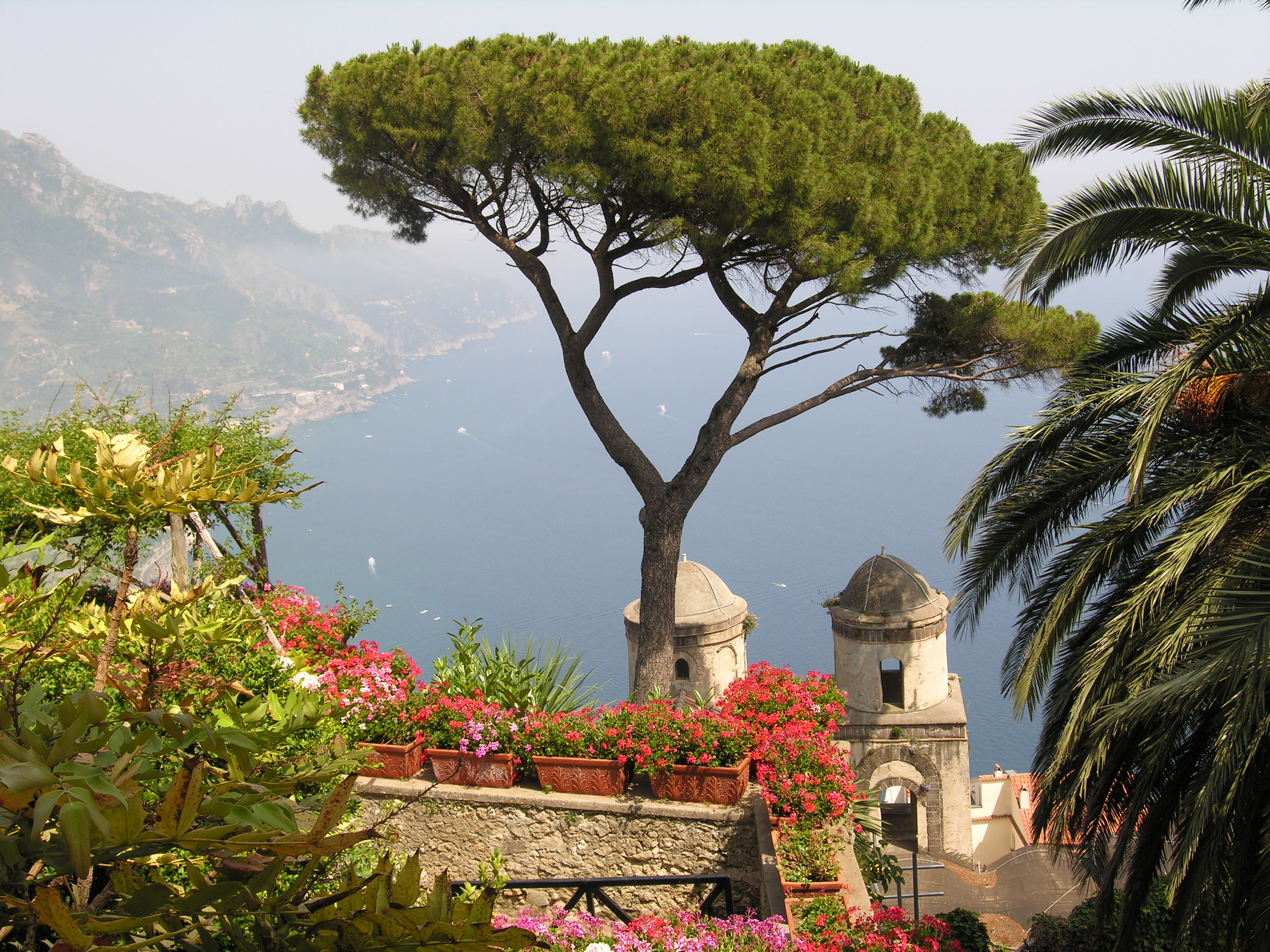
Ravello is a charming and quiet seaside resort, rich of art
and history; it is a terrace overlooking the sea (m. 350), from which you enjoys
a unequalled scenary of natural beauties. From its viewpoints the Amalfitan
coast shows an enchanting vision. The city is known as the Città della Musica
because of the classical music concerts held here. It is located on the ridge
projecting from the mountain that divides the Valle del Dragone (Dragon's
Valley) and del Regina. Based at 350 meters on the sea level, Ravello overhangs
the underlying towns of Minori and Maiori. This enchanted place is among the
most beautiful in the whole Amalfi Coast, with an intense and unique landscape.
It is renowned for its peacefulness and the deep fascination it emanates from
each corner and its image is mostly connected with villas with breathtaking
views seen all around the world by pictures. Ravello is a village with a very
ancient history. It has been built on a rock high 350 meters from the cliffs of
the Coast of Amalfi. From Ravello you can see an exalting view, where subsequent
terraces declining to the sea have been transformed by the work of generations
of men in green terraces cultivated with lemon trees and dotted with white
houses. Ravello is like an open terrace facing the sea, a point from which we
can appreciate panoramas of unique natural beauty. From its dizzy heights, the
view of the Amalfi Coast is simply breathtaking. The places where you can take
the most beautiful view are the gardens of the ancient Villas of Ravello: Villa
Rufolo and Villa Cimbrone.
Villa Rufolo takes its name from an ancient family
of Ravello, rich and powerful in the times of the Maritime Republic of Amalfi.
The villa suffered carelessness and degradation until in 1851 the Scottish
Francis Neville Reid bought it and brought it again to the ancient splendor. In
1880 Wagner, who stayed in the Villa for some time, remained astonished by the
extraordinary glamour of the place and here he found the inspiration to compose
the second act of the "Parsifal". From that time, the Villa continued to attract
visitors and artists and personages as Jacqueline Kennedy and Illary Clinton.
During the summer performances of classic music and ballets of the highest level
take place at night in the garden of the villa. The garden becomes a charming
scenery, with the orchestra playing on a stage hanging between the sky and the
sea.
Villa Cimbrone lies down on seven hectares of rocky terraces peaking on
the sea. It had been brought in 1904 by Lord Grimthorpe, who embellished the
Villa with antiquities coming from every place of Italy and made in the garden
walks of statues and little temples. The most suggestive walk is called "The
Walk of the Infinite", because it ends with a belvedere, where the height above
the sea and the view can leave you breathless.
Ravello was a bustling centre
of commercial activity. Between the XI and XII centuries many trading routes
were active among Ravello, the Middle East and Sicily. The Arab-Sicilian
architecture of many of the buildings in Ravello still reminds us of those
ancient exchanges. Ravello possesses many building of high artistic merit, most
of them constructed by wealthy merchants.
The cathedral dates back to the XII
century. Its facade has two smaller entrances, which wing either side of the
main doors of the marble portal. The doors are in bronze, a fine craft by
Barisano of Trani, and date back to the year 1179. The XIII century bell tower
is decorated with many ornamental arches.
The dream-like views, the lush
vegetation and the charming atmosphere make Ravello a "must see" for those
visiting the Amalfi Coast.
What visit in Ravello
* The Cathedral
of St. Pantaleone: it was originally built by bishop Papirio in the later 11th
century, but has subsequently undergrone considerable alterations, especially in
the 18th century, which have alterde its spirit, though leaving its underlying
structure substantially intact. The Cathedral is flanked by a handsome campanile
dating to the 14th century, and entered through magnificent bronze doors made by
Barisanus of Trani in 1179. The interior is notable for its magnificent Pulpit
dating to the 13th century. The Pulpit represents a wonderful fusion of the
classic, Byzantine and Saracenic style. Opposite it stands a no less magnificent
Ambo. The nave and the transepts are decorated with paintings of some value,
while the choir is adorned with a handsome episcopale throne and paschal
candelabrum. The Chapel of San Pantaleone houses the reliquaries of the blood of
the Saint to whom the Cathedral is dedicated.
* Museo del Duomo: it is
situated in the crypt and keeps, among other interesting works, the bust of
Sighelgaita Rufolo, one of the most beautiful sculptures of the XIII century,
the reliquaries of S. Barbara (XII century) and S. Lorenzo (XV century), the
altar marble mosaic relics (1272), tomb slabs (XV century) and an outstanding
pluteus with relieves and mosaic.
* Villa Rufolo: this made up of a whole
series of buildings and gardens set on the wide terraces overlooking the sea,
offering a unique panorama of Amalfi's coastline from Capo d'Orso to Conca dei
Marini. The wealthy Rufolo family made its fortune trading in the Middle East.
They were not only merchants but also skilful bankers, and they built the villa
in the 13th century. The villa ws later owned by the Confalone family, the
d'Affitto family and, in 1815, it was bought by the Scotsman, Francis Neville
Reed, who commissioned Michele Ruggiero to restore it. Over the centuries, the
villa has had many illustrious guest, including kings, queens, popes and
personalities from the world of art and culture. THe present entrance is in the
Torre Minore, with its small arches and Moorish-inspired decorations. The
vestibule takes us into a pleasant shady avenue lined with cypress trees,
leading to the Cloister or Moorish Courtyard, which is now almost all in ruins.
Looking over the balustrade on the right, we can admire what is left of the
Cloister or, rather, what has been saved by restoration. The loggia above the
ogival arches is composed of small pairs of columns supporting beautiful
arabesques, surmounted by more pairs of terracotta columns below the decorated
walls. From here we preceed to the upper garden on the right there is a part of
the villa which houses animals and fragments from the ancient cathedral. From
the top of the 30 metre high Torre Maggiore on the left, we can enjoy a view
over the whole of Ravello. This was once the defende tower, with its narrow
stairway and simple interior. On the second floor, there are two double
mullioned windows on each side, and three round windows, whilst on the third
floor there is a series of double terracotta columns like those in the Torre
Minore. Beyond the well and the Sala dei Cavalieri, we reach the belvedere, a
spacious terrace overlooking the sea, abounding in trees and exotic plants. Two
staircases led down from each side of this balcony to the lower terrace with its
brightly-coloured perfumed gardens. "This is the magic garden of Klingsor"
exclaimed Richard Wagner in 1880, dazzled by the splendour of the colourful
flowers and intoxicated by fantastic vegetation. It was in this harmonious
setting that the great German musician wrote the 4th scene of Act II of
Parfisal. Each year, a series of Wagner concerts are organized in the gardens,
in this fairytale, setting against a backcloth of sea and sky.
* Villa
Cimbrone: from Villa Rufolo, we take the winding steps up via S. Francesco
leading to the church of San Francesco, which is said to have been founded by
St. Francis in 1222, and rebuilt in the 18th century. There are two entrances in
the atrium the main entrance leads into the church, which has a single nave with
two altars on each side. It was originally Gothic, as we ca see from the ogival
transept and apse. The church houses the marble tomb of Beato Bonaventura of
Potenza, which was transeferred there from San Giovanni del Toro. The smaller
door leads to the square Romanesque cloister with its double and single columns.
Continuing our journey along past the quiet old buildings to Santa Chiara and
its nunery, we finally reach the flight of steps leading to the garden of Villa
Cimbrone. The Villa was built by the Acconciagiacomo family, and later taken
over by the Fusco family, the Amici di Atrani and finally by William Beckett
(later Lord Grimthorpe). To the left the entrance is the Cloister, whit its
double mullioned windows, arches and central well, in imitation of the San
Francesco clositer. Despie the presence of contrasting elements, the overall
effect is very pleasing and orginal in addition to the works in wrought iron,
the wooden statues and stuccoes, there are two fine bas-relief sculputures of
nine Norman Warriors and the seven Deadly Sins. The crypt is also on the left as
we enter, and is an unusual contemporary construction in Gothic style, which
offers a fine view over the southern part of the Amalfi coas. The colonnade is
composed of twenty-two pillars in grey stone, each with eight horozontal bands
both the vault and the arcades are pointed, in mock Gothic style. Our visit
continues to the Castle, with its small mullioned and loop-holes in different
styles, and its two tower. In addition to housing a fine collection of works of
art, many seminars and conferences have been held there, and it has many famous
guests. We now begin a tour of the gardens beyond the Ponte del Roseto, along
the avenue with its beds of reses, camelias, hydrangeas and geraniums on one
side and luxuriant trees and shrubs on the other, we find various construction
and ornamental statues Mercury (copy of the Hermes at rest in the Museo
Nazionale in Naples), Bacchus' Temple (with a small avenue lined with cypress
trees leading up to it), Eve's Grotto with its statue of Venus by the Roman
sculptor Tadolini, and a small temple with six columns and wrought-iron dome. We
finally reach the Belvedere, a wide balcony decorated wih marble busts, wich
offers a marvellous view over the Gulf of Salerno, Punta Licosa, Punta della
Campanella and the coast around Amalfi from Capo d'Orso to Conca dei marini. We
can also see Maiori, Minori, Catiglioni (Ravello beach), Atrani, and the various
district of Amalfi dotted about the promontory abd dominated by the ancient
Torre dello Ziro. Our tour of the gardens end at the Roseto, with its staues,
amphoras and fountains, and finally the Tea-Room, a rectangular room with
columns arrangedin pairs, and walls decorated with arabesques in imitation of
the Cloister of Villa Rufolo. Opposite the Tea-Room are four ancient carved
columns, two bronze fawns and a stone shell decorated with sea
scenes.
Cumpa Cosimo is a one of a kind restaurant with excellent Italian food. You will meet the owner of the restaurant who is a friendly woman, Netta, who makes sure you are satisfied with the quality of your meal. It is a relaxed atmosphere and some dishes are made family style. There is so much to choose from with genuine southern Italian cooking with top quality ingredients. It is a special place that you will not forget. The most authentic restaurant anywhere. Small, very inviting - burning fireplace was very charming. It was as if your long lost Italian grandmother invited you over. She spoiled us with delicious soup, crusty bread and brought my daughter hand-cut "french fries" seasoned to perfection while she waited for her canneloni. The house white wine went perfectly with my linguine with mushrooms. There are not enough good adjectives to describe the personality, quality and value of this restaurant. ---46 Via Roma, Ravello, Italy
Da Nino Pizzeria Take Away-
Parco Della Rimembranza
35/37, 84010
Ravello, Italy
What a gem we found in this little take-away restaurant! The pizzas were the
best price in town & so delicious. The perfect place to grab delicious,
homemade Italian food for a picnic. We also tried all of the grilled verdure--eggplant, zucchini,
broccoli, peppers and potatoes--all generously portioned and well priced. Their
eggplant parmigiana was one of the best I've tasted. The people that worked
there were incredibly friendly.
The best buffalo mozzarella cheese starts with the best care for animals
A queue forms for rub-downs as jazz piano tinkles out of
the speakers: some of the best buffalo mozzarella in the world starts
with in-stable VIP treatment.
Ducky, Sweety and Lady
lumber towards the sound system, attracted to the smooth Keith Jarrett
licks at the exclusive Tenuta Vannulo dairy in southern Italy.
"The music helps them produce more milk because the animal feels more relaxed," said Valentina Michelucci, astable hand.
The
half-tonne black water buffaloes spend their days lounging on rubber
mattresses, munching on organic hay or looking forward to vaporised
showers that form a fine cooling mist from overhead pipes.
When
they feel the urge, they saunter into a special pen for automatic
milking by a unique machine that knows the exact shape of each udder
thanks to a code emitted by the electronic collars the buffaloes wear.
Or
they can head to large round brushes that twist into action when the
animals come into contact with them, providing a soothing back and
shoulders massage.
"Animals have to be treated well to produce stress-free milk," Antonio Palmieri, owner of the 200-hectare (500-acre) farm said.
"They
can't speak for themselves so it's up to us to understand how they want
to be cared for," he said, sitting in a manicured garden next to his
three stables, which house 500 buffaloes.
The farm sells around 300 kilogrammes (800 pounds) of mozzarella per day for 13 euros a kilo -- nearly $8 a pound.
There's
just one catch: If you want it, you have to drive to the farm, 50
kilometres (30 miles) south of Salerno, to buy it, as Palmieri does not
bother with distribution -- or marketing, for that matter.
Brisk business
Business
is brisk anyway, thanks to the dairy's word-of-mouth fame and
international reputation among jet-setting buffalo milk aficionados.
Around 45,000 customers visited the on-site farm shop in August alone.
The
staple remains mozzarella but Vannulo also make a range of buffalo
milk-based products including yoghurt, ice cream and, starting next
year, chocolate.
Vannulo's "is widely regarded as the
best mozzarella," said Piero Sardo, president of the Foundation for
Biodiversity at Slow Food, an Italy-based international gourmet and
eco-friendly farming group.
"The well-being of
animals is an important issue," said Sardo, a cheese expert, although he
admitted that the link between better treatment and tastier milk was
scientifically "difficult to prove".
The history of
buffalo dairying in Italy has been traced to the 12th century, but it
remained a mainly local affair until relatively recently because of the
difficulties in refrigerating the milk.
Before the 1980s, most dairies in the region were small producers like Vannulo.
But
in recent years, buffalo mozzarella has gone international and is now
prized in the best restaurants from Dubai to Moscow to Sydney. The
coveted cheese sells for 30 euros a kilo in Russia.
Best Food to Eat in Campania By Lisa Fantino Italians love to eat but the cuisine of the northern region of Tuscany is quite different from that of the southern region of Campania. Northern dishes are traditionally more meaty and hearty, like a ribollita; while those in the south highlight fish because of their proximity to the sea. Yet, that’s not to say that any less attention is given to incredible pasta dishes and desserts. So here are the Top 5 dishes to try while touring Campania Sfogliatella – No trip to Naples or Amalfi would be complete without trying one of these delicious pastries for breakfast. The multi layers of light dough are formed into the shape of a seashell and offer the perfect crunch to compliment your morning latte or cappuccino. AUTHOR’s PREFERENCE – while I have eaten fantastic sfogliatelle in Campania, some of the best I have ever tasted can be found at the coffee stands inside Rome Fiumicino airport.
Farfalle alla Caprese – These little bowtie or butterfly shaped pasta are cooked al dente and tossed with select virgin olive oil, fresh mozzarella, basil, garlic and sun-ripened tomatoes which have the unique flavor of the lava-rich hills of the region. This is served at room temperature but can be served hot so that the cheese just melts over the pasta.
Fried Zucchini Blossoms – This is a seasonal delicacy that always seems to magically appear on the Amalfi Coast no matter the time of year. In Campania, they stuff these tender orange flowers with ricotta and batter and fry them. You will not find these on the so-called “tourist menu” which offer things like
Chicken Parmigiana, Mamma mia!
Stuffed Calamari or Cuttle Fish – stuffings are as varied for this little squiggly fish as the day is long. However, the stuffing is what makes this dish. Breadcrumbs are the base to which various ingredients such as pignoli, raisin, gorgonzola, onions, garlic and seasoning are added. They are then baked and served as an entrée. They are cooked to perfection when the fish just melts in your mouth.
Dolce – The Napoletani enjoy their desserts. One of the most enjoyable pastimes is to grab a café in a piazza, along with a babbá (rum-soaked cake).
Visits to the Tomb of Saint Peter and the Necropolis under the Vatican Basilica
Special visits to the necropolis underneath the Basilica, where the tomb of St. Peter is located, are only possible following special permission granted from time to time by the “Fabbrica di San Pietro”. Visits are organized according to the schedule set by the Excavations Office.
- In order to preserve this exceptional historical, archaeological site and due to the limited premises around the venerated tomb of the Apostle Peter, only around 250 visitors per day are permitted to enter. - Groups are composed of approximately 12 people and according to language. - Only those who are 15 years or older will be admitted – no exceptions will be made. - Each group is accompanied by a guide especially trained by our office. The guided visit lasts about an hour and a half.
We kindly inform all visitors to the necropolis that environmental conditions will be different underground, with possible increase of temperature and humidity. Those who suffer specific and serious physical problems that could be effected by these conditions, including claustrophobia, should not visit. Virtual Visit: Explore the Vatican Necropolis online by clicking the following link: http://www.vatican.va/various/basiliche/necropoli/scavi_english.html RESERVATIONS: Requests, if possible, should be sent directly by the interested visitor/s. If the person submitting the request is not the actual visitor, he or she should send the visitor(s) name(s) and e-mail address(es). This will allow the Excavations Office to replay back to the person requesting the visit and to the visitor with specific information about the visit granted. Those leading groups (universities, parishes, cultural associations, agencies, and other groups) should send a complete list of names of the participants and the name of their organization. There are no set deadlines for submitting requests. All requests, even urgent ones, will be fulfilled depending on the places left available at the closest date to the one requested. Requests may be submitted in written form by sending a message to scavi@fsp.va,by fax +39 06 69873017, or by visiting the Excavations Office in person (using the south [left] entrance, just outside of the Colonnade). It is absolutely necessary to provide the following information: 1. Exact number of participants; 2. Names of participants; 3. Language requested; 4. Possible dates *when the Excavations Office can assign your visit (the time will be determined by the Office). *please always write in full the name of the month (e.g.: from 01 January 2013 to 08 January 2013) 5. E-mail address, or fax number, or a complete postal address. ENTRANCE FEE: The cost of the individual ticket, including the contribution for the Guide, is 12,00 Euros(approximately $ 15.50 USD) [From January 1, 2013: The cost of the individual ticket is 13,00 Euros(approximately $ 16.50 USD)]. No reductions in price will be given for any reason. REGULATIONS DURING VISITS: Arrive at the Excavations Office at least 10 minutes beforethe scheduled time of the visit. Clothing should be appropriate for a sacred place: long trousers/slacks/jeansfor men; dresses that reach below the kneesor long trousers/slacks/jeans for women; shoulders must be coveredfor all. Entrance to the Excavations Office is onlythrough the gates located on the Via Paolo VI (outside of the Colonnade, just to the south [left], near the entrance to the General Audience Hall.) Upon arrival, present the Swiss Guards with your letter of confirmation received from the Office which indicates the scheduled time of your visit. Depositing prohibited items: The following objects are absolutely prohibited during the visit: luggage / large bags backpacks /cameras These [and similar] objects must be deposited before reaching the Office. A DEPOSIT area free of charge for these objects is available to the right of the façade of the Basilica at ground floor level of the Basilica's premises passed the security check areas. We are glad to provide this service and the objects deposited are supervised by our staff. Anyone who does not observe these regulations will not be allowed to participate in the visit. OFFICE HOURS:
Monday – Friday:
9:00 a.m. – 6:00 p.m.
Saturday:
9:00 a.m. – 5:00 p.m.
The last visit always begins at 3:30 p.m. (4:15p.m. from April through September).